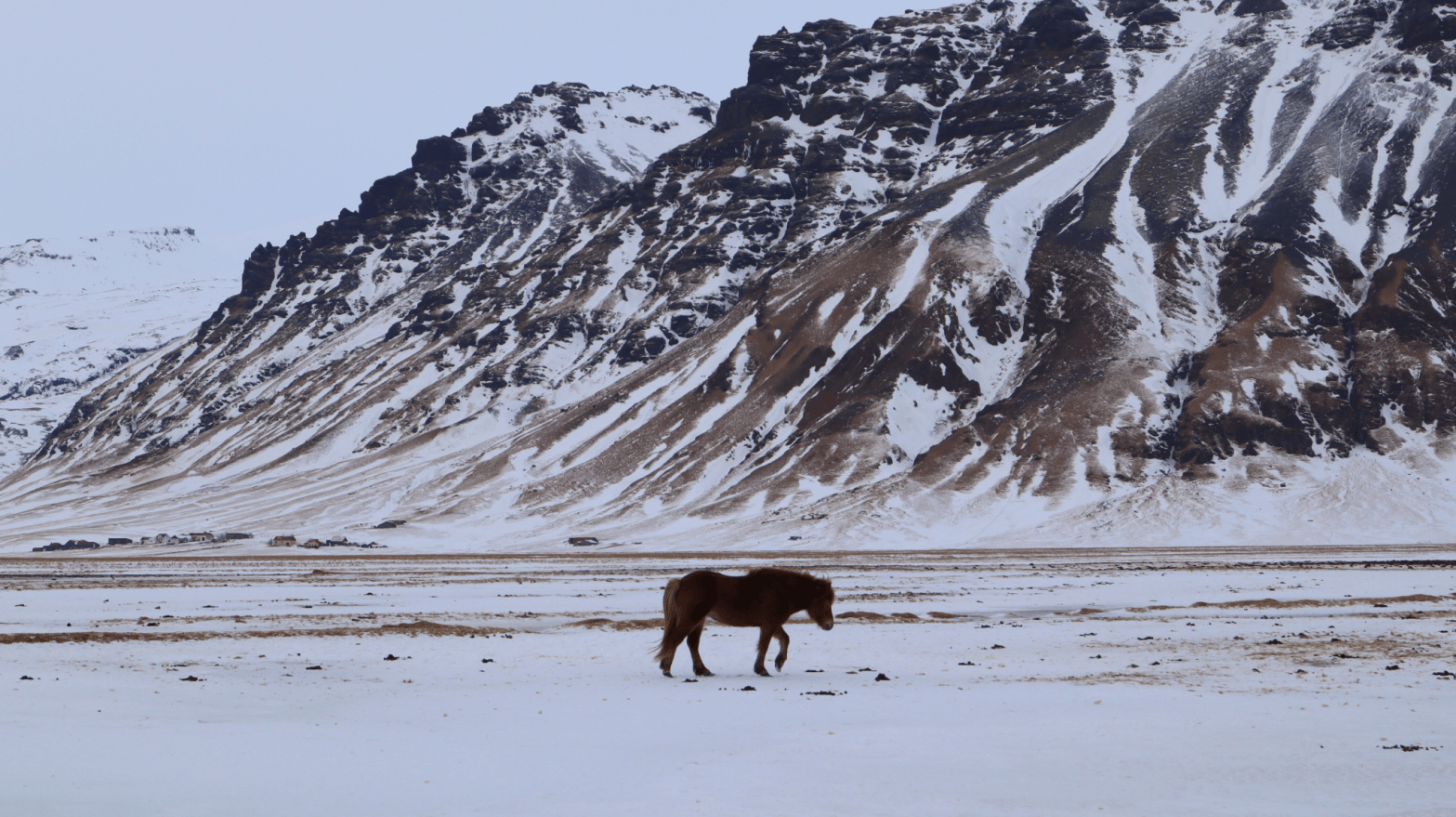
Welcome to Iceland’s South Coast, where water, fire and ice, like the colours in Iceland’s flag, cross paths to reveal dramatic landscapes and enchanting natural wonders. I’ll take you through majestic glaciers, breathtaking waterfalls and the famous Black Sand Beach and tell you myths and legends about these beautiful places, preserved and passed down from one generation to another.
1. Sólheimajökull
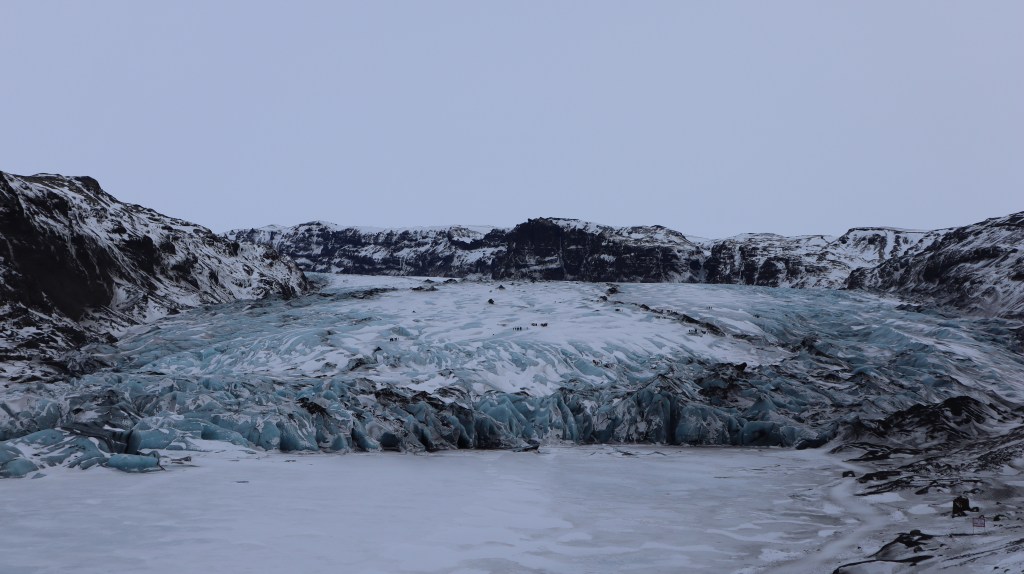
One of the most easily accessible outlet glaciers from Reykjavik by car, Sólheimajökull is an intimidating sight to see. Its size reaches 8km in length and 2km in width. Sólheimajökull is part of the Mýrdalsjökull ice cap which is the fourth largest glacier in Iceland and covers around 595km2. For reference, below I’ve included an image of Sólheimajökull’s size compared to the entire Mýrdalsjökull ice cap.

Mindblowing, right? What if I told you that Vatnajökull, Iceland’s largest glacier, is more than 13 times the size of Mýrdalsjökull? It’s the largest glacier mass in Europe covering approximately 7,900 km². Now that’s impressive!
Back to Sólheimajökull! It’s such a popular and accessible tourist attraction that it’s hard to see the place completely empty. It takes less that 5 minutes to get from the car park to the glacier lagoon, and another 10 minutes to get to the glacier wall itself. It’s not only a sight to see and admire but you can also hike on the glacier with proper equipment and a guide (definitely on my to-do list one day).
An interesting fact about glacial ice is that it’s quite different to the ice you get from your freezer. It melts slower. But also… it’s blue and there’s a scientific reason behind it!
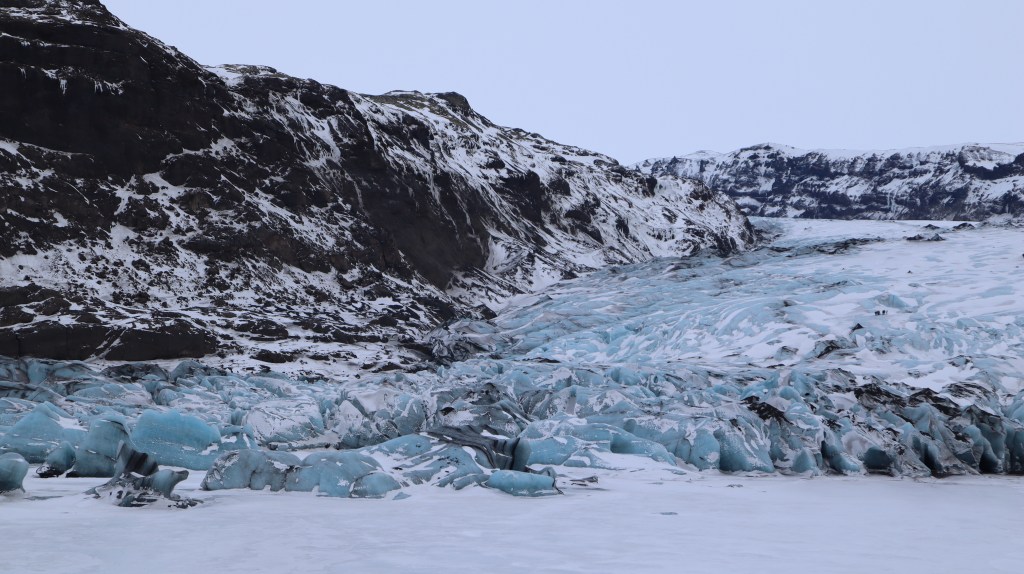
Glaciers are large, thick masses of ice that form on land when fallen snow gets compressed into ice over centuries. The bigger and heavier the glacier, the more compressed the ice becomes and during that compression air bubbles are squeezed out, increasing the density of the created ice. Ice absorbs light to different extents depending on its density and the light’s wavelength. Longer wavelengths, such as red, orange, and yellow, have lower energy and are more easily absorbed or scattered by the molecules in the ice. Blue light, with its shorter wavelength and higher energy, is scattered less by the molecules in the ice. This allows it to penetrate deeper into the ice before being absorbed, giving glaciers their blue colour. So pretty!
2. Skógafoss
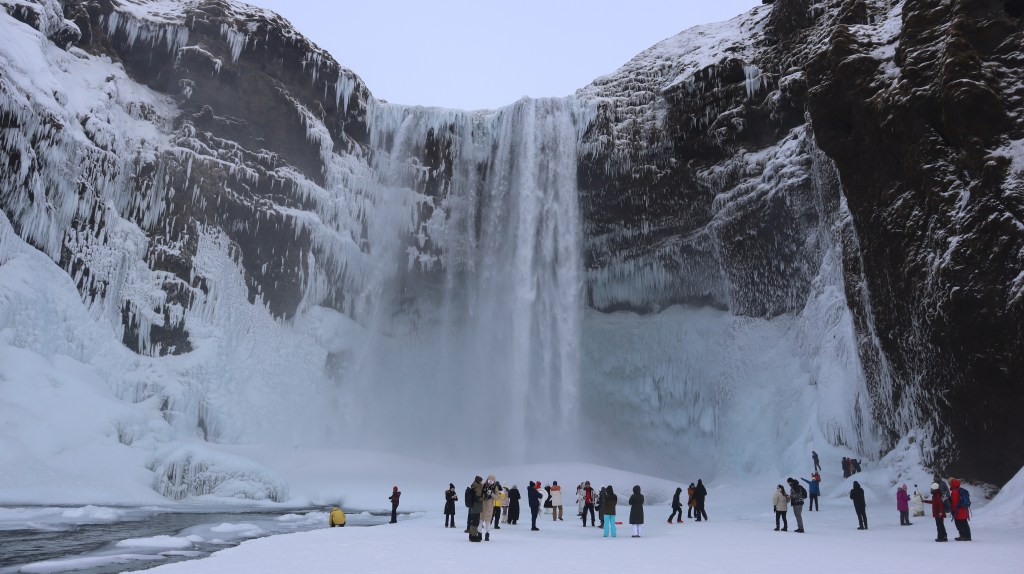
This is one of the biggest waterfalls in Iceland and it was featured in Season 8 of Game of Thrones as part of the landscape beyond the Wall in the North. With a drop of 60m and a width of 25m, it’s hard not to feel like an ant next to it. If you visit Skógafoss on a sunny day you’re very likely to see a single or even double rainbow due to the amount of spray produced by the waterfall. On the right side of it, there are stairs (527 of them… not that I counted) that lead to the top of the waterfall and reveal a wonderful panoramic view which is worth the effort. Be careful if you’re visiting in the winter months as the stairs can become slippery – like everything in Iceland during that time. It’s always best practice to bring crampons (ice cleats) with you or you can also buy them on your arrival in Reykjavik. At least 1 or 2 shops are selling this kind of equipment around every corner in the city centre.

Like most landmarks in Iceland, there is a legend about Skógafoss (and no, this one doesn’t mention trolls or dwarves). Legend has it that long ago, when the first Viking (Þrasi Þórólfsson) settled in this area, he buried a treasure chest behind the waterfall. Then in the year 1600, three men found the treasure chest and tried to get it by placing a hook on one of its rings. As they were dragging the chest towards them, the ring broke off and the chest disappeared into the waterfall never to be seen again. It is said that this same ring is now on the door of the church in Skógar. You’re more than welcome to look for the treasure when you visit Skógafoss – just remember to share it with me if you do find it. Sharing is caring!
3. Vik i Myrdal
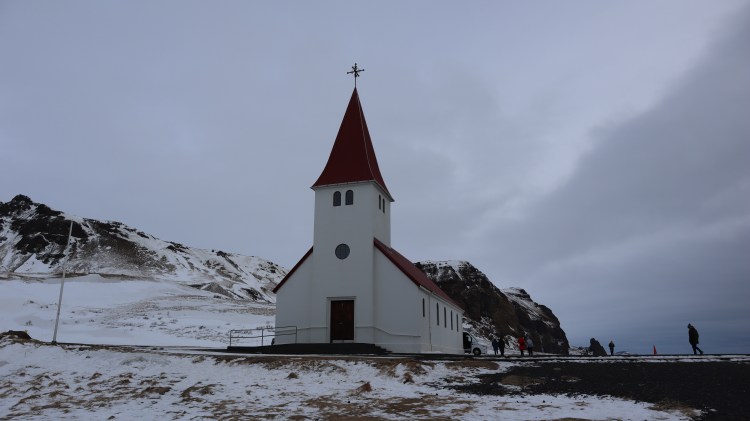
Commonly referred to as just “Vik”, Vik i Myrdal is a small village on the southern coast of Iceland with a population of 300-400 residents. It’s a popular spot for tourists exploring the southern part of Iceland as it is surrounded by natural wonders – from the iconic Reynisfjara (Black Sand Beach) to the Mýrdalsjökull glacier and the Katla volcano, which lies beneath it. There is a church on top of the village hill called Víkurkirkja. Since its construction in 1934, the church has remained an important cultural and religious symbol for the local community. Many visitors of Vik also climb the hill to admire the panoramic view of the village and coastline it offers.

From the top of the hill, you can see the impressive rock formations at Reynisfjara which are also known as Reynisdrangar, an integral part of Icelandic folklore. Can you tell where I’m going with this? There’s a legend about them! Long ago, those rock formations were once trolls trying to pull a ship ashore. They pulled and pulled and pulled for hours but they were caught by the sunlight of dawn, which turned them into stone, a common fate that awaits trolls who stay out until dawn. Harsh isn’t it? The more I learn about trolls in folklore, the more I’m starting to feel bad for these guys. For the most part, they were just clumsy, greedy and a bit stupid, but aren’t we all sometimes?
4. Reynisfjara (Black Sand Beach)

I can almost bet that even if you didn’t know where Reynisfjara was located, at some point, you would’ve seen it on Instagram, in films and commercials. Despite being THE black sand beach of Iceland, it’s not the only one in the country but it sure is the most popular for a reason. The combination of black sand, fierce North-Atlantic waves and towering rock formations leaves any visitor in awe. Reynisfjara’s black sand is made up of Basalt, a type of rock that forms as a result of the rapid cooling and solidifying of volcanic lava (from Katla volcano), which comes in contact with the ocean. Over time and with the help of the strong waves and winds, the basaltic rock formations are broken down into smaller particles which we call black sand.
Putting the otherworldly appearance of this place aside, there are hidden dangers at Reynisfjara and they’re called sneaker waves. Those are waves that appear suddenly in a train of smaller waves and can sweep visitors standing too close to the water’s edge. Unfortunately, over the years there have been multiple incidents – some of them fatal. As a response, the Icelandic Road and Coastal Administration developed and installed a light by the beach’s parking lot which flashes in yellow or red (never green) based on a wave forecasting system.
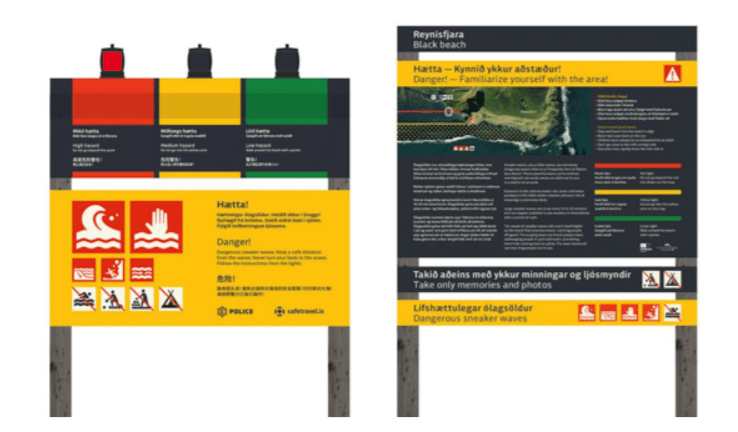
So, keep an eye out for the colour of the light when visiting and stay away from the water’s edge. Trust me… the view looks even better from afar!
P.S.: For all of my Game of Thrones geeks, Reynisfjara was the filming location for Eastwatch-by-the-sea, where Jon Snow and his warriors ventured into the wild to prove the existence of the White Walkers. Thankfully, they weren’t attacked by trolls, although I’m not sure what’s worse… Icelandic trolls or the White Walkers?
5. Seljalandsfoss
Seljalandsfoss waterfall is part of the Seljalands river, which originates from the Eyjafjallajökull volcano glacier (also referred to as E15 because it’s that much easier to say “E15” instead of “Eyjafjallajökull”). The waterfall drops 60m and is one of the few in Iceland that you can walk behind if you’re prepared to get wet. An interesting fact about this area is that it was once submerged beneath the Atlantic Ocean. As the waters receded over time, they revealed this beautiful scenery.

You might also recognize Seljalandsfoss from Justin Bieber’s “I’ll Show You” music video.
But it’s not just Biebs who clearly loves Iceland’s nature. Artists like David Guetta, Take That, Zara Larsson, Avril Lavigne and many more have also chosen to feature this magical country in their music videos.
It’s crazy re-watching them on YouTube now and thinking “I’ve been there too”!
If you’re planning your next adventure in Iceland or simply want to know more about the country, stay tuned for my next blog post about the Golden Circle!
 IVCEPTION